Monday, March 28, 2016

The Asian Carp vs The Great Lakes -- Thomas Kelly

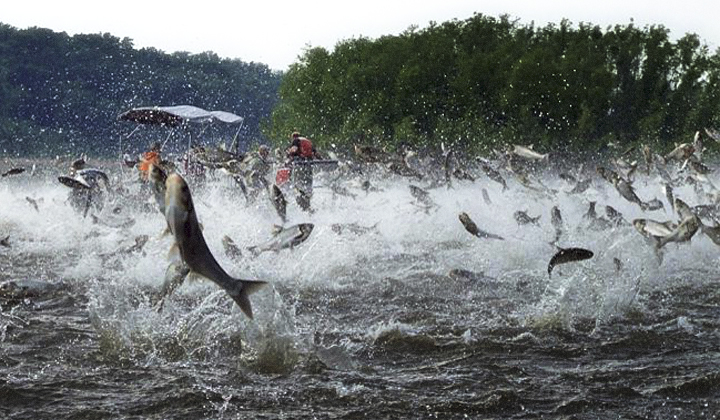
The Midwest of the Untied States specifically the Great Lakes, Mississippi River, and Illinois River are fighting a pesky fish. The Asian Carp is a fish that has the potential to destroy the ecosystems of these areas. This fish is a veracious eater which can potentially eat up to 100x its body weight. These fish are starting to cripple areas of the Mississippi and Illinois river due to their monster like eating habits. These fish are not native to these areas as you can see from their names. They were brought to the United States to help keep aquaculture facilities clean and to provide as fish to fish markets. Unfortunately they escaped into the wild  and began their reign of terror. There are two types of Asian carp, the bighead and silver carp, and they average a weight of 30-40 pounds. But there has been a few river monsters reported that grow up to 100 pounds. The big problem that the people of the midwest are having right now is that the Asian Carp are encroaching into the Great Lake territory. The Great Lakes fishing industry brings in over $7 billion in revenue. The Asian Carp are already responsible for destroying some ecosystems in the Mississippi and Illinois river. Officials are doing what ever they can to keep the Asian Carp out of the Great Lakes so that they don't ruin that as well.
http://themissouritimes.com/wp-content/uploads/2014/09/Asian-Carp01.jpg
There is a potential catastrophe that is bound to happen to in the Great Lakes and its vital ecosystem. The Great Lakes make up the largest fresh water ecosystem in the world and it must be protected. The main problem is that Asian Carp feed mainly on plankton and algae and have the ability to eat tremendous amounts of it. The Asian Carp eat substantial amounts of plankton and algae and don't leave enough for the native species of the ecosystem. The Asian Carp does not have many predators because it is so new to the ecosystem. Therefore their populations continue to rise.  When the Asian Carp eats all the plankton and algae that the native species have been eating it for centuries the ecosystem begins to crumble layer by layer. There are so many other species that need to eat the plankton and algae to survive and the Asian Carp are stealing their food source. If a single Asian Carp finds its way into a Great Lake their ecosystems can crumble in a matter of years.

I have read that their are many different entry points that the Asian Carp can use to enter into any of the 5 Great Lakes. The National Wildlife Federation is doing all they can to stop this potential catastrophe by setting up underwater electrical fences, hydrologic separation, and putting no limits on the number of fish caught. I believe that if these fish do find a way into any of the Great Lakes America is going to have a big problem on its hands. Due to the money and  I think that NWF and the U.S. Army Corps of Engineers need to get all the help they can and find a way to prevent the Asian Carp from entering these vital lakes.

Sources:
1."What We Do to Stop Asian Carp - National Wildlife Federation." What We Do to Stop Asian Carp - National Wildlife Federation. N.p., n.d. Web. 28 Mar. 2016.2.Vroman, M. E. "Will Asian Carp Take over the Great Lakes?" Water and Society (2011): n. pag. Web.3.3."Asian Carp Response in the Midwest." The Problem. N.p., n.d. Web. 28 Mar. 2016.

Thursday, March 17, 2016

Climate Change Impacts Algal Blooms - Elena Covill

Toxic algal blooms, often referred to as “red tide,” are a natural cyclical process in which algae such as Pseudo-nitzschia become so abundant in the environment that the ocean becomes discolored. In addition to starving the water of oxygen, this algae releases toxins such as domoic acid and saxitoxin into the environment, which can lead to large numbers of fish deaths, and which may make fish unsafe for human consumption. For this reason, these blooms can be a big problem for the fishing industry, which would like to find some way to prevent the algal blooms. Unfortunately for fisherman, the blooms have been increasing in duration and frequency since the 1980’s. Scientists believe that this may be due to climate change, which is leading to changes in ocean acidity and temperature. As the temperature of the oceans rise, the algae is able to travel farther from the equator as well, with toxins from the algae showing up in tested animals as far north as Alaska.


Red tide events can add stress to an ecosystem, and can exacerbate problems already present. For instance, if an area is being overfished, a severe algal bloom could further decrease fish populations, potentially leading to extinction. In this hypothetical case, the species would already be in a precarious position due to human activities, and the outside intervention of a red tide event could push them past an ecological tipping point from which they could not recover.

Additionally, the fact that the algal blooms are possibly being intensified by climate change, which is a result of human activity, is an example of negative human impacts on the environment. Worsening red tides would be an indirect effect of human actions, but would be an example of a positive feedback loop, as the changes causes by human interference and by climate change on the ocean ecosystems lead to red tide, which could worsen existing environmental problems caused by the changing ecosystem.

The fact that toxic algal blooms have become more problematic in recent years seems to be a major indicator of the wide-ranging impacts of global climate change. Warmer ocean temperatures are enabling more frequent and severe takeovers by toxic algae, which might suggest the possibility of an ocean overruled by toxic algae, similar to the idea of an ocean overrun by algae as suggested in “The Rise of Slime.” I believe that this issue is something that should be given a good deal of attention, as it is both caused by human behavior and impacting it. Issues such as these are the type which will hopefully garner attention and lead to changes in human behavior.

Sources:

Dovey D (2015) “Climate Change May Be Behind Toxic Red Tide That Has Poisoned Marine Life And Shut Down Fisheries Along The West Coast.” Medical Daily. http://www.medicaldaily.com/climate-change-may-be-behind-toxic-red-tide-has-poisoned-marine-life-and-shut-down-346530

Herring A (2013) “The rising red tide with climate change.” Phys.org http://phys.org/news/2013-05-red-tide-climate.html

Pascual K (2016) “Climate Change May Boost Frequent Blooms Of Toxic Algae.” Tech Times. http://www.techtimes.com/articles/140817/20160315/climate-change-may-boost-frequent-blooms-of-toxic-algae.htm

Coral Bleaching - Jenna Smith

What is coral bleaching? Coral bleaching is the whitening of diverse invertebrate taxa, resulting from the loss of symbiotic zooxantellae as well as the reduction in photosynthetic pigment concentrations in residing zooxantellae within scleracintian corals. In simpler terms, coral bleaching is when corals are stressed by changing conditions including, temperature, light and nutrients, they expel algae living within their tissue, causing them to turn completely white. The issue with global climate is thought to play a major role in this destruction of coral reefs. In the worse scenario, global climate change will result in the complete extinction of many coral species.
            Coral reefs are found in circumtropical shallow tropical waters, generally along the shores of island as well as continents. The composition of these reefs includes the calcium carbonate from both living and dead scleractinian corals. The living organisms, including invertebrates, vertebrates and plant life allow these corals to have an extremely high productivity and biodiversity. The coloration the corals receive is due to the zooxanthellae living within their tissue.
            On a worldwide scale coral reef ecosystems have been subject to unprotected degradation over the past few decades. Anthropogenic impacts to coral reefs include, overexploitation, overfishing and nutrient overloading. Natural disturbances include violent storms, flooding as well as high and low temperature extremes. Beginning in the 1980s the frequency in destruction and reported coral bleaching has increased. This widespread bleaching, resulting in mass coral mortality is beginning to raise concerns about the link between global phenomenon’s such as global warming and increased UV radiation due to the ozone depletion.
            Coral reef bleaching is a general response to stress that can be determined but a variety of factors or combinations. Bleaching occurs when the densities of zooxanthellae decline or the photosynthetic pigmentations drop. Depending on the severity, usually corals can regain their algae within several weeks to a few months. However, the loss of the zooxanthellae is prolonged, the stress on the coral continues and the populations of zooxanthellae do not recover, resulting in the death of that particular coral. The increased temperatures of the waters have shown to induce the disruption of enzyme systems in the zooxanthellae that tend to protect against oxygen toxicity. At temperatures above thirty degrees Celsius the zooxanthellae photosynthesis pathways have been shown to be impaired. Bleaching is frequently reported from elevated seawater temperature during the mid summer season lasting approximately five to ten weeks. Also in the summer months, the shallow living coral is exposed to increased solar radiation. Both photosynthetic active radiation and ultra violet radiation have been shown to result in the bleaching of coral.
            If a global warmer trend continues, the impacts on coral reefs are expected to increase at frequent rates. Coral mortality could exceed ninety five percent regionally with the addition of extinctions as well. However, even if a significant sea warming does not occur, coral reef degradation will still continue due to anthropogenic pollution and overexploitation as a result in unrelenting human population growth.
            I believe that coral bleaching is a major issue. Coral bleaching is a topic that relates to the course in a multitude of ways. Ecology deals with the study of organisms between one another and their environment. Coral reef bleaching shows the negative impact humans and other environmental factors can have of a species. In turn, humans in this case also have the ability to help prevent or slow the degradation if coral reefs by being aware of the issue therefore, allowing people to be more conscious with their actions.

Sources:

Wednesday, March 16, 2016

A Non-native Species: Garðyrkjuskóli Ríkisins' Icelandic Banana Plantaion By: Emese Dunn


                                Banana Plantation on Iceland? 2015. Imgur.com, n.p.


           Garðyrkjuskóli Ríkisins, (the Horticulture College; now known as the Icelandic Agricultural University), hosts one the largest banana plantations in northern Europe.  Of course, there isn’t a lot of competition, but the fact that bananas grow so near the arctic circle at all, is quite a feat.  Iceland’s arctic conditions seem no home for a tropical plant like a banana, but volcanic hot spring activity make this seemingly impossible enterprise quite viable.  Iceland only receives four hours of daylight during the winter months, but these bananas still survive, even thrive, in their volcanic hot springs habitat.  Garðyrkjuskóli Ríkisins uses green energy, harnessing the heat from the volcanic springs to warm the bananas’ surroundings.  Bananas normally produce all year round, but these “cold weather” plants have a shorter production season: April to June; and it takes approximately one and a half to two years for the fruit crop to mature, where as it take only a few months near the equator to reach maturity.  The university, located near the city of Hveragerði planted it’s first banana tree around 1950 as an experiment.  When the study was complete, proving that bananas could grow in greenhouses in Iceland, Garðyrkjuskóli Ríkisins decided to continue producing bananas, “just for fun,” even though it wasn’t economically advantageous. 

          Although bananas are a non-native species to Iceland, this is an example of how good environmental husbandry allows non-native species to grow in a way that isn’t invasive or detrimental to the natural habitat.  Iceland’s climate doesn’t lend itself to the over run of bananas and because of this the bananas don’t threaten any other plant species.  The Icelandic bananas can only grow in very controlled environments, thus garanteeing a healthy variety of plant species that Iceland doesn’t naturally have without the possibility of invasion.  Although the “large” plantation consisting of only a few hundred trees doesn’t provide enough fruit to fuel the entire nation of only 320,000 people, it does produce about one ton of fruit which is consumed by students and faculty.  The plantation also provides jobs for gardeners employed at Garðyrkjuskóli Ríkisins as well as suppling a small revenue from tourist attraction.   


Citations: 


Friis, Kasper. "A Banana Grows in Iceland." Atlas Obscura. N.p., 08 Mar. 2016. Web. 16 Mar. 2016.

"The Mythical Banana Kingdom Of Iceland - The Reykjavik Grapevine."The Reykjavik Grapevine. N.p., 02 Dec. 2013. Web. 16 Mar. 2016.

Photo: Banana Plantation on Iceland? 2015. Imgur.com, n.p.


Sunday, March 13, 2016

Coral Bleaching How Much More Can Species Take? - Austin Nagell


The glue that holds together the ecosystems of the Great Barrier Reefs around the world is facing drastic threats. The glue that I am referring to is coral and it’s not as strong as it once was. This organism interacts with many others forming multiple symbiotic relationships that even further intertwine the complexities of the Great Barrier Reef ecosystems. For the coral its endosymbiotic relationship with zooxanthellae is its most precious, seeing as it’s needed for its very survival. The zooxanthellae (algae) help the coral remove wastes and produce oxygen and on the other hand the algae gets a safe environment to live in.  
Rising ocean temperatures have been steadily putting more stress on coral causing it to lose the algae it needs. This problem called coral bleaching causes the algae that gives the coral its color to die causing the coral to turn bleached shade. Normally coral can recover from this bleaching, but as the globe continues to warm the problem of coral bleaching has more commonly become prevalent. These warmer conditions make the process of coral bleaching occur yearly in many areas. Annual coral bleaching has minimal research but a study conducted by members of The Ohio State University and The University of Delaware showed interesting results. Through their 2 year long experiment they found that varying species of coral have different capabilities to adapt to annual coral bleaching while other species do not possess this capability at all. Further research is needed to better determine the corals acclimation over a longer period of annual bleaching. The species that could adapt to this very minimal length of bleaching may not be able to survive longer annual bleaching periods. This further research may conclude that even the adaptive coral may be unable to withstand the ever increasing stress that global warming is providing.
            This problem of coral bleaching fits right into the very definition of Ecology. The interactions and byproducts of human activity greatly influence and alter the habitats of a wide variety of organisms. The alterations that have happened to the earth in the blip of time that humans have lived on it are utterly detrimental. Global warming, pollution, habitat destruction, and many other factors devastatingly contribute to not only the mortality of coral but also to the extreme loss of biodiversity in general that has recently taken place. This annihilation and loss of life will continue to have immense negative effects until the human race decides to prioritize our earth’s health. We must stop treating nature as a separate entity and understand that its wellbeing directly corresponds to ours.

Image Source: 
http://www.newheavendiveschool.com/articles/coral-bleaching/
 Study Source:
Grottoli, A. G., Warner, M. E., Levas, S. J., Aschaffenburg, M. D., Schoepf, V., McGinley, M., Baumann, J. and Matsui, Y. (2014), The cumulative impact of annual coral bleaching can turn some coral species winners into losers. Glob Change Biol, 20: 3823–3833. doi:10.1111/gcb.12658