Thursday, February 18, 2016

Global Nitrogen Footprint

For the first time ever at the end of January 2016, an international collaboration allowed for the global nitrogen footprint to be mapped and it gave shocking results. The footprint encompassed 188 countries, and found that 4 countries are responsible for almost half of the world's nitrogen emissions. The United States, China, India, and Brazil are responsible for 46% of the world's nitrogen emissions. Aside from these top 4 countries, results found that developing countries tended to embody larger amounts of nitrogen emissions from their exports of food, textiles and clothing. High-income nations are responsible for more than 10 times the emissions of the poorest nations. Majority of the emissions were a result of agricultural, transport and energy generation industries. Emissions produced from consumers were due to sewage. According to researchers, nitrogen pollution is becoming an increasingly significant problem because countries not only consume the naturally occurring element but also produce greater quantities of synthetic nitrogen. 


Nitrogen international trade routes and intensity
Image Credit: University of Sydney

This is an incredibly relevant topic to our course because it relates back to the incredible impact humans have on our planet. While efforts to conserve our planet and reduce our pollution are in effect, it does not change the fact that we put a heavy burden on our planet. 

I believe that the increase in nitrogen emissions is an important problem that we should be more aware of. I, however, think it is a difficult problem to tackle at the same time because the synthetic nitrogen is used to produce fertilizers which are used worldwide. While it is ideal for everyone to eat organic fruits and vegetables on which fertilizers are not allowed, it might not be realistic. Organic fruits and vegetables are more expensive, and after fertilizers being such a common resource for companies who mass-produce for world-wide distribution, it would be difficult considering how it would affect their supply. 

Sources:

The Magic Bin - Iyana Ashby


     For years now we have been trying our best to save our animals who love the water from dying because of ocean pollution and oil spills in the ocean, but according to Herreria "Two Australian surfers have quit their jobs and come up with a brilliant solution to combat the millions of tons of trash in our oceans". Their invention is called the Seabin and it acts as a water filtration system like the ones in fishtanks, but used for the entire ocean instead. It separates the trash from the water and then the oil from the water, flowing the now clean non polluted water back into the ocean. They are mainly used at floating docks for now and suck up trash from harbors close by. How they plan on cleaning the oceans is, "By starting close to the source of the problem in a controlled environment", such as marinas and yacht clubs. "By working with these 
marinas, ports and yacht clubs we can locate the seabin in the perfect place 
and mother nature brings us the rubbish to catch it". Our course, Principles of Ecology, revolves around discussions and issues going on in the environment and how we can try to sustain resources and maintain sustainability on earth. This machine is something that can help do that, by not having a lot of money be spent on harbor cleaning methods and also not have fuel wasted on giant boats with nets to go search for the garbage and remove it. It even reduces the noise pollution from the boats that are used to get rid of the trash. I believe this invention is amazing and kind of sad that it took so long to come about. The fact that fish, other living organisms and sea animals do not get caught in the Seabin is even better. I think the Seabins should be made a lot larger though since the ocean is massive, but I am excited too see that less animals (hopefully none) will be getting stuck in oil spills and with plastic wrapped around their necks anymore, which is happening to ducks, penguins and other sea creatures as I am typing this blog entry. 

Source and Image: http://www.huffingtonpost.com/entry/seabin-ocean-bucket_us_5681d22fe4b06fa68880fc60

Wednesday, February 17, 2016

Indian Bat Endangerment by Hemraj Persaud

                The Indian Bat (Myotis sodalist) is one of many species that are considered endangered. The reason the Indian Bat is endangered is mostly because human activity has greatly decreased its population. Climate change also plays a large role in the decline of the Indian Bat population. With rising temperatures the ideal climate for the Indian Bat has declined. The western range (Missouri, Iowa, Illinois, Kentucky, Indiana, and Ohio) which is currently considered the heart of Indiana bat maternity range looks like it will become unsuitable in the future under climates modeled created by the U.S Forest Service. Temperature change effect the Indian Bat more than other mammals because their reproductive cycles, hibernation patterns and migration are closely tied to temperature.

                Climate change isn’t the only thing affecting the Indian Bat. Indirect human activity also has an effect on the Indian Bat. Activities such as creating new cave entrances increase the temperature and humidity of the cave making it unsuitable for the bats. Constructions of gates near bat colonies trap the bats making them easier to be prayed on by predators. Humans have also directly decreased the population of Indian Bats by killing them. Along with human activity, the spared of White Nose Syndrome has also affected the Indian Bat population. WNS is a condition in which fungus ( Pseudogymnoascus destructans) grows around the muzzle and wings of hibernation bats. As of 2012 WNS has led to the deaths of 5.7 to 6.7 million bat deaths.


            The endangerment of Indian bats is related to this class because human activity has both directly and indirectly endangered an entire species. Ecology is about the relationship between organisms and their surroundings. Humans directly affect the surrounding of the Indian Bat due to climate change and human needs. It is important that we try our best not to reduce the bat’s population even more since the Indian Bat is important to its ecosystem and to humans. For example the Indian Bat main sources of food are insects, which mean that if the Indian Bat were to go extinct the insect population would increase. An increase in insect population would directly affect farmers and their farms. I think that it is terrible that human activity has affected the Indian Bat especially since they help in the reduction of insects, which lessens our reliance on pesticides. I think that stronger regulations are needed to protect the caves Indian Bats use since we cannot stop climate change in the near future. The Indian Bats are already struggling with White Nose Syndrome; we shouldn’t make their survival any more difficult.   

http://www.safarisamblog.com/breaking-the-bat-myth/


USDA Forest Service ‑ Southern Research Station. "Climate change projected to alter Indiana bat maternity range." ScienceDaily. ScienceDaily, 28 January 2013. <www.sciencedaily.com/releases/2013/01/130128191233.htm>.

http://www.iucnredlist.org/details/14136/0

http://biology.eku.edu/bats/indianabat.htm

Increasing Climate Change 
By Michael Montaruli 


From: livescience.com

As we know climate change is becoming a more concerning topic in society and politics today, especially after 2015, which set the record for the greatest increase in climate change. When you realize that 2015 broke the record for the hottest year after 2014 set the record the year before that’s when we should probably concerned. This is now the fourth time the record has been broken since the year 2000. This is important because this increase in climate change can cause major damage to many different ecosystems. Some affects that can directly affect humans are the cause of droughts, which ruin the production of crops and an increase in hurricanes, which are life threatening storms for people who might be affected.
            There are many other species that are affected by climate change that which affects their respected ecosystems. The most known information about climate change destroying an ecosystem is the melting ice caps which is endangering polar bears, seals, penguins, and arctic fish life. Some other animals and ecosystems that people don’t tend to think about are other animals such as the North Atlantic right whale, the panda, and the orangutan. These animals are affected by climate change because the increase in temperature affects the living of the plankton for the whales, it affects the growth rate for the bamboo for the pandas, and it increases the duration of droughts for the orangutan.

            I believe that climate change is a serious and growing topic that needs to be dealt with in a more serious manor. The most obvious actions that we can do are to greatly reduce emissions of C02 and deforestation. I believe that this increase in climate change has gotten to the point where government officials have to start making strict heavy laws and regulations to help the issue. There should be heavily regulated laws that help companies safely dispose of any harmful wastes and help to reduce the amount of emissions produced. Dealing with deforestation is a problem that does not only affect the United States but all other countries of the world. Deforestation cannot just be dealt with on an individual effort. It is going to take the entire earth as a whole to save the forests because the number of species that would be destroyed if we are to continue cutting down all these trees is simply too many. These are two main causes of climate change and must be dealt with quickly if we are going to continue to live on this planet. 

Thursday, February 11, 2016

Gulf of Mexico Finds Potentially Invasive Species
Jaime Peacock


"In fairytales, it's usually the damsel who is in distress. When it comes to the marine world, however, it seems it's the damsel that can cause some distress." In this case, it is the beautiful damselfish, often found in homes and businesses, which have been found outside of areas that they are native to. Typically found in the Red Sea and the Indo-Pacific, the regal damselfish was recently discovered in the coral reefs of the Southern Gulf of Mexico near Veracruz. Among the ways that the fish could have found themselves inhabiting these new areas include from large ships that have accidentally transported them in their ballast tanks across the ocean or simply by people dumping their household fish either into the ocean directly or into waters that feed into the ocean. In the article, Matthew Johnson, Ph.D., a marine researcher at Nova Southeastern University (NSU) and one part of a group researching the spread and impact of invasive species at the university discussed the importance of realizing that just because a fish isn’t necessarily deemed dangerous, their increasing population in areas that they are not native to makes them an invasive species and in turn can hurt the natural balance of the ecosystem in that area. He emphasizes this by saying, “You don’t have to be an apex predator, have huge teeth or venomous spines to be a negative force on a reef – you just have to be where you’re really not supposed to be and compete for the reef’s limited resources.” Johnston and a fellow researcher simulated the forecast of the spread of the species and while it does not appear that they are spreading too quickly, they are beginning to wreak havoc on the reefs in the southern Gulf of Mexico.
                This relates to the course in regards to the balance of species and the affects that a small change can have on the entire ecosystem. This topic, while seemingly minute, can be seen in other areas and other species. It seems as though educating people on simple policies, such as not dumping certain fish into waters that they do not belong, could be an easy and effective way to prevent some of these issues of invasive species in the future.


Wednesday, February 10, 2016

Black Bass Might Save Papa New Guinea

by Bryan Goossens
Taken from article by John R. Pratt 
             Papa New Guinea (PNG) is a Lower Developed Country, with the average citizen making less than $6 each day. That equates to about $2,000 per year, which is not sustainable. PNG has seen a huge population jump in the past few years as well. It has “increased by 40 percent in recent years, and 38 percent of the population was under the age of 15 at the time of the last census in 2011” (John R. Platt). Growing populations mean that there needs to be more space for humans to live. PNG used to be filled with rainforests but they have been decreasing rapidly to make space and for other purposes. Logging has also been occurring so that they can make money and it looked like it would continue to happen, along with mining and other plantations to sustain the human growth.

            The solution to this problem could be from an unknown species. The Niugini black bass could save PNG. Fishermen have paid thousands of dollars to try and catch this behemoth fish, which weigh from 45-65 lbs. Most experts consider it the toughest fighting sport fish, which makes it a challenge to the top fishermen in the world. This creates a source of income for PNG and the opportunity to stop logging and mining. Scientists do not know a lot about this fish still and need to make sure that enough exist so they can learn about them and plan on creating fish hatcheries to ensure its long term survival. They plan on allowing people to pay to try and catch them but will be forced to release them. This will ensure that it is a renewable resource, meaning that they cannot be used up before they can reproduce.

            This is a great opportunity for PNG. There will be a tipping point where they have cut down too much of the rainforest and then they will not be able to do anything to replenish it. The rainforest is needed to keep the ecosystem in balance, losing the rainforest affects many different biotic and abiotic factors. The animals and plants living there will have nowhere to live and no food to eat. The quality of the water and air will be affected for the worse as well. When looking at the IPAT model, since it is an LDC, the growing population and lack of technology will have a huge impact on the environment and the logging and mining needed to stop, or at least slow down. This fish looks like it would be extremely difficult to catch and if I had money, I would pay money to try and catch it! I hope this plan works and the PNG will be able to take advantage of this great opportunity.

Pratt, John R. "A Mysterious River Monster Could Help Save Papua New Guinea's Rainforests."  TakePart. N.p., n.d. Web. 10 Feb. 2016. <http://www.takepart.com/article/2016/02/10/river-monster-could-help-save-papua-new-guinea-s-impoverished-people>.
"Niugini Black Bass." « Research. N.p., n.d. Web. 10 Feb. 2016. <http://www.niuginiblackbassresearch.com/black-bass/>.

Tuesday, February 9, 2016

The Affects of Climate Change on Cold Blooded Animals
Brittany Marino


            According to an article published by Science Daily, scientists can study the behavior of animals based on their body temperature to determine how the Earths climate changes will affect cold blooded animals. The University of Missouri-Columbia writes, "Cold-blooded animals like lizards, insects and fish have a preferred body temperature range at which they hunt, eat, move quickly and reproduce. Fear that a warming climate will constrict this temperature range underlies recent studies that warn of the detrimental effects of climate change on the activity and survival of cold-blooded animals. While not contradicting these warnings, a new paper offers a revised framework that may better answer how activity is affected by temperature". 
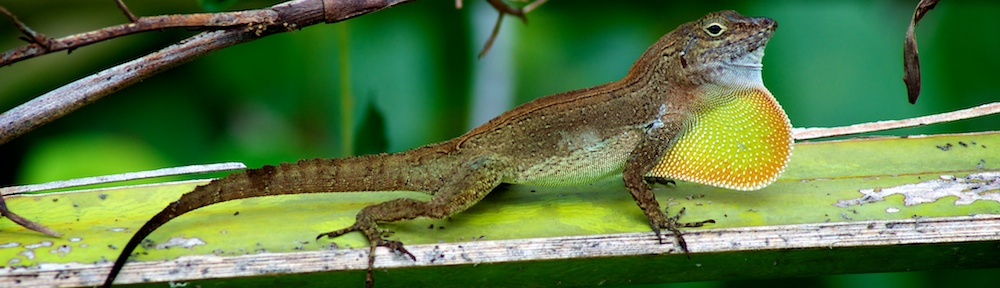
            Students at the University of Missouri-Columbia took a look at the Anolis Cristatellus, a tree dwelling lizard that is found in both wet and dry habitats in Puerto Rico. They observed the lizards behavior when exposed to different temperatures and discovered that cold blooded animals have preferred body temperatures that, when reached, will perform certain behaviors, such as eating, sleeping, and running. It was found that without the lizards body temperature being in the "preferred range", the lizard would not perform the tasks needed for its survival. If the climate issue is not resolved, life for cold blooded animals will become very difficult and we could see the extinction of many species in the future. 
          This article relates to our ecology class because ecology is the study of how organisms interact with their environment. Cold blooded animals interact with their habitat by using heat to trigger behavior. If for some reason the lizards environment changes, they will need to adapt very quickly or become endangered and even extinct. I think that this information is very important in that we can see how climate change will affect the lives of species around us and how, eventually, our destruction of the Earth will hurt every being on the planet. 

Citation:
University of Missouri-Columbia. "New framework sheds light on how, not if, climate change affects cold-blooded animals." ScienceDaily. ScienceDaily, 19 January 2016. <www.sciencedaily.com/releases/2016/01/160119142111.htm>.


Image:
http://www.anoleannals.org/wp-content/comment-image/1126.jpgB