Friday, January 29, 2016

Eat Invasive Species
Maggie Pugliano
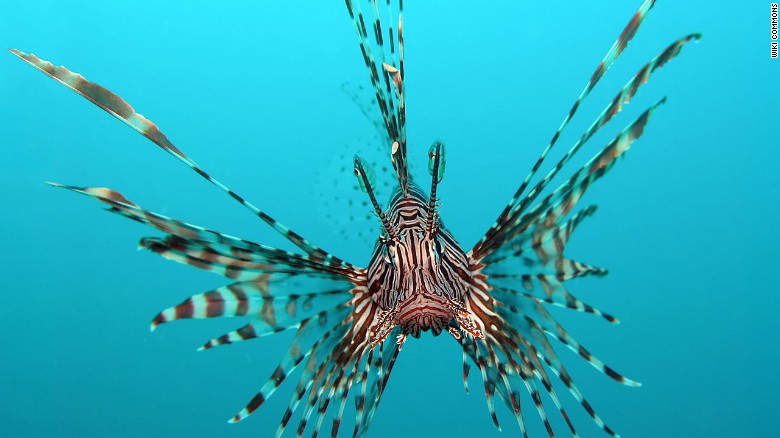


The lionfish is an invasive species that can be found from the United States East Coast to the Caribbean. It is poisonous and it has very few predators. They eat everything (including themselves) and are a danger to native fish. Females can lay 2 million eggs every year. The National Oceanic and Atmospheric Administration (NOAA) is allowing the fish to be caught by fishermen and sold to put on menus for people to eat. In Florida, local restaurants have the fish on their menus. Reef, an environmental group made lionfish derbies for people to catch the fish and they even created a recipe book. The general public’s demand for these fish is not high, but it is becoming trendy for people who follow sustainable lifestyles to eat them. The article is calling this an ‘invasivore’ movement, meaning that people would eat invasive species. By introducing these species into meals, it will make people aware of the issues surrounding invasive species. When people are aware, they can try to prevent moving species from one place to another.
This article relates to Principles of Ecology because ecology is the study of the interactions of organisms between each other and their environments. An example of an interaction is how humans can bring an invasive species into an area where it is not native. It is important that we consider this interaction because it can cause damage to existing populations. 
I think that this is an interesting approach to take to eliminate invasive species. I do not think it will work for all of the organisms, but it is a good step in the right direction. I think that there needs to be more articles like this to educate people on the importance of keeping invasive species out of  non-native areas.

Citations
Image

Tuesday, January 26, 2016

Free-Market Environmentalism: A Real-World Solution to a Serious Problem by Liam MacDonald

Students for Liberty, September 25th 2013. 
   
From the time of the presidency of Theodore Roosevelt, politicians at the federal level have been pushing for legislation and regulation that serves to protect the environment. When TR nationalized the Parks Services in the 1906 American Antiquities Act, he was the first president to ever enforce environmental legislation (1). Since then, American presidents have enacted more regulation on both large corporations and the American people, most of the legislation making sense for both sides. However, in recent years as climate change has become part of the political and social vernacular, there are those who clamor for even more governmental regulation that has cost the American taxpayers hundreds of billions of dollars. In 2012, federal environmental regulations cost the American government more than $216 billion in regulatory government costs, and amounted to a year's worth of paperwork for more than 40,000 federal employees (2). With well over half the country opposed to raising federal taxes, the current regulatory system is not a sustainable long-term solution (3).

In 1991, Eco-friendly capitalist economists Donald Leal and Terry Anderson published a book, entitled Free Market Environmentalism. In the book, Leal and Anderson argued that deregulating the economy and letting the educated consumer decide their own ecological path, rather than relying on government interference in the free market, will help the environment more than any governing force short of totalitarianism (4). In  small doses, the results of FME have been overwhelmingly positive. Entrepreneurship and ingenuity led by free market environmentalists has restored grazing rights for over 500,000 acres worth of bison in Yellowstone National Park, and helped to bring about fishery management zones in India where the government failed (5). If trends like these continue on a larger scale, free market environmentalism could spur the next great innovation in saving the planet. 

There are several ways in which free-market environmentalism relates to this course. Firstly, FME has emerged as a response to the environmental concerns that plague our world today, and has been a much-talked about phenomenon in recent years as an alternative to corporate punishment. Additionally, free market environmentalism could serve to increase cooperation between governments and large businesses. FME also forces those in the business world to recognize the impact that humans have on the environment, and stresses the importance of protecting our planet with real-world solutions, Lastly, free-market environmentalism encourages us as consumers to buy the most Eco-conscious materials that we can buy and to help make our world more sustainable. 

As for me, I personally think that FME is a realistic solution that could make a big difference in helping the environment. Throughout history, when humans have been able to harness their full potential, we have seen the most innovation to further progress us as a species. It is true that the steps taken by Roosevelt and Presidents Johnson, Nixon and Ford were necessary and remain so today. However, I am of the belief that we can't let bureaucracy quell innovation in the market, and that continued government overreach and interference in the private sector rarely works well in the long run. Ultimately, I think that cooperation between environmental entrepreneurs who wish to see a longer-lasting, sustainable planet and a government that allows them to do so is the best solution to our climate change problem. 

Citations:
1.    United States. National Park Service. "Theodore Roosevelt and Conservation." National Parks Service. U.S. Department of the Interior, 15 Jan. 2016. Web. 26 Jan. 2016.

2.       Anderson, Terry. "Free Market Environmentalism." Hoover Institution. N.p., 19 Feb. 2015. Web. 26 Jan. 2016.

3.       "Taxes." Gallup.com. Gallup, n.d. Web. 26 Jan. 2016.

4.   Anderson, Terry. "Free Market Environmentalism." Hoover Institution. N.p., 19 Feb. 2015. Web. 26 Jan. 2016.


5.       Anderson, Terry. "Free Market Environmentalism." Hoover Institution. N.p., 19 Feb. 2015. Web. 26 Jan. 2016.


The Constant Threat of Invasive Species by Bryce Lipinski

    To many people, introducing a nonnative species to an established ecosystem may not seem like it could have a significant impact, but it actually has the potential to disrupt many of the life processes of the species that currently inhabit the local area. In recent news, nonnative regal damselfish (Neopomacentrus cyanomos) have been discovered off the coral reefs near Veracruz, Mexico (1). Although there are native damselfish in the Gulf of Mexico, this new species is native to the Red Sea, the Indo-Pacific, and often found in household aquariums (1). Researchers have studied oceanic currents and the preferred environmental factors for the nonnative damselfish to predict how impactful this growing population could become. As a nonnative species establishes itself into the local food web, there are several native species that have the potential to be outcompeted. As mentioned in class, when a nonnative species enters a new habitat, it no longer faces its natural predators that help control the population size. The species is defined as invasive when it harms an existing ecosystem. Although invasive species are not likely to cause a native species to go extinct, they are capable of causing local extinctions (2). 
    One of the most difficult components of this issue is how easy it is to accidentally spread an invasive species. The researchers investigating the invasive damselfish suggested that someone could have established the current population simply by releasing the contents on an aquarium.1 Another possible explanation is that the fish were transported in the ballast tanks of a cargo ship. These ships often take in water from one location and expel it in another part of the world while making their delivery. Once an invasive species becomes established, there is very little that can be done to eradicate it from the ecosystem. Over 100 billion dollars is spent each year in the United States in an effort to combat invasive species (2). This enormous amount of money still has very little effect, which is why I believe that the focus should be on preventing any potential invasive species from spreading in the first place. There should be stronger regulations to reduce the spread due to human ignorance. One example would be to require cargo ships to sterilize their ballast tanks in order to remove anything that might be accidentally getting moved with the cargo (2). If this example was in place, it could have prevented the invasive damselfish from entering the Gulf of Mexico. 


Regal Damselfish
Credit: John E. Randall, Ph.D., Hawaii Biological Survey


References:
(1) Nova Southeastern University. "Potential invasive species identified in S. Gulf of Mexico: Research shows non-native damselfish in part of Gulf." ScienceDaily. ScienceDaily, 19 January 2016. (http://www.sciencedaily.com/releases/2016/01/160119141800.htm)
(2) Miller, G. Tyler, and Scott Spoolman. Essentials of Ecology. Australia: National Geographic Learning, 2015. Print.